OPTICAL MECHANICAL SPLICE: QUICK TO INSTALL – BUT MAY INCREASE MAINTENANCE COSTS OVER TIME
When a quick repair today becomes a maintenance challenge tomorrow
For 1FO subscriber fiber cables, optical mechanical splices are commonly used because they are quick and easy to install without requiring a fusion splicer. They can be an effective solution when service needs to be restored quickly.
However, for long-term network operation, it is important to consider not only the initial repair time, but also the stability of the splice point and future maintenance costs.
Advantages of Optical Mechanical Splices
- Quick and easy installation.
- No fusion splicer required.
- Low initial investment.
- Suitable for fast service restoration.
Limitations to Consider
An optical mechanical splice is a mechanical connection, so its performance depends on fiber preparation, cleaving, cleanliness, alignment and the quality of the splice itself.
Over time, factors such as temperature, humidity, vibration, cable tension and mechanical impact may affect the connection. If the splice performance changes, insertion loss may increase and affect optical signal quality.
When a splice point requires repeated troubleshooting or replacement, the actual cost goes beyond the price of the splice itself.
Material + labor + transportation + troubleshooting time + service downtime = higher long-term maintenance costs.
THE ALTERNATIVE: FUSION SPLICING WITH VT-42M4
Instead of focusing only on restoring connectivity as quickly as possible, network operators can adopt a fusion splicing solution using the VT-42M4, combined with the VT-42FO for testing.
RECOMMENDED REPAIR PROCESS
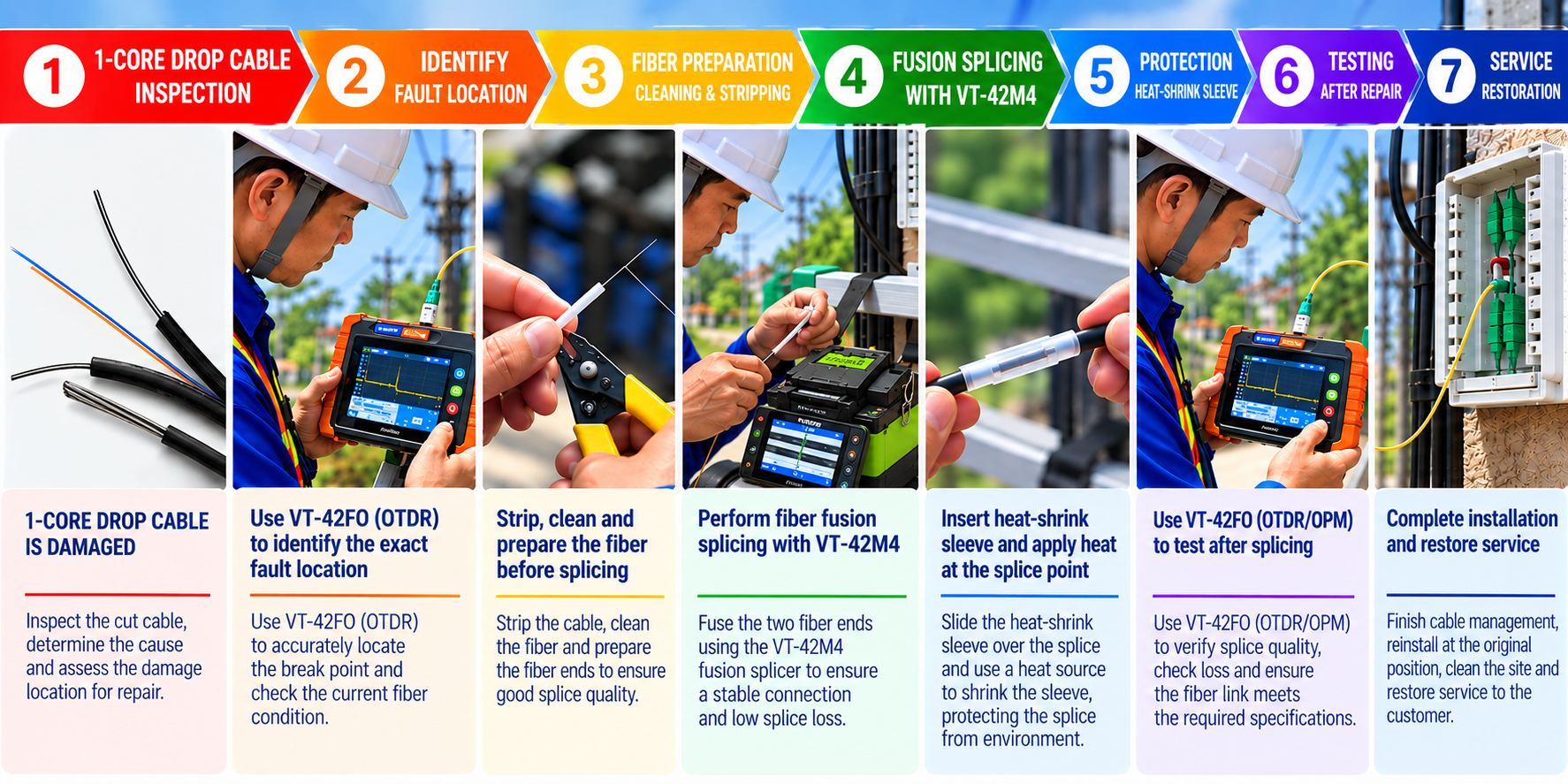
WHY CONSIDER FUSION SPLICING?
Direct fiber-to-fiber connection
Fusion splicing creates a direct connection between two fiber ends, helping achieve low and stable splice loss when properly performed.
Better mechanical protection
The fusion splice can be protected with a heat-shrink sleeve and 1FO splice closure, helping protect the connection from mechanical stress.